
TIG Welders: What We Actually Recommend for Shops
Shopping for a TIG welder? This guide covers the specs that matter, which machines fit different shop sizes and budgets, and the Lincoln Electric and ESAB models our team would shortlist. When you’re ready to compare, browse our full selection of TIG welders for current pricing and package options.
Back in May, we covered the MIG welding machines we’d recommend for a working shop. Now we’re looking at TIG welders, where choosing the right machine depends on what you weld, how often you weld it and how much control your work requires.
The first question is whether you need AC/DC capability. DC handles plenty of steel and stainless work, but aluminum requires AC. It’s worth thinking about that before you buy, especially if your shop’s workload could change over the next few years.
From there, you’ll want to look at amperage range, duty cycle, starting method and torch setup. We’ll walk through what matters, which machines make sense for different shops and where we’d spend the money.
The five specs that matter when choosing a TIG welder
You don’t need every feature available on a TIG welding machine. You need the features that match your materials, workload and budget. These five are the best place to start.
AC/DC capability
This is one of the first decisions to make. DC works for mild steel, stainless steel and chrome-moly. Aluminum welding requires AC, so you’ll need an AC/DC TIG welder if aluminum is part of the job.
If you’re only welding steel today, a DC-only machine may be enough. But if aluminum could become part of your workload, buying AC/DC now can save you from replacing the machine later.
Amperage range
Maximum amperage gets plenty of attention, but don’t overlook the low end. Higher amperage gives you more capacity for thicker materials, while stable low-amperage performance helps when you’re working with thin stainless, sheet metal or small components.
Think about the materials you weld most often rather than choosing a machine based on its maximum output alone.
Duty cycle
Duty cycle tells you how long a machine can weld at a specified output during a 10-minute period before it needs to cool.
For example, a 40% duty cycle at a given amperage means four minutes of welding and six minutes of cooling within that period. Always compare duty cycles at the same amperage. A rating at a lower output won’t tell you much about how the machine will perform during your actual work.
For production shops running long beads or handling repeated welds, duty cycle deserves particular attention.
Pulse
Pulse alternates between higher peak current and lower background current. It can help manage heat input while maintaining penetration, which is useful when working with thin stainless steel and other heat-sensitive materials.
It can also help welders maintain a consistent rhythm when feeding filler rod. If your work involves thin materials, appearance-sensitive welds or repeatable results, pulse is a feature worth considering.
High-frequency start
High-frequency (HF) start establishes the arc without touching the tungsten electrode to the workpiece. That helps reduce tungsten contamination and makes starting easier when cleanliness matters.
Lift-arc start can be a practical option for occasional DC TIG work, particularly on a multi-process machine. For AC aluminum work, look for a machine with the appropriate HF starting capability.
Choosing a TIG welder for your material
Your material should drive the machine choice. Here’s how we’d approach the decision.
- Mild steel: DC is sufficient for most TIG applications involving mild steel. If TIG is only an occasional task in a shop that primarily uses MIG welding equipment, a multi-process machine with DC lift TIG may be all you need.
- Stainless steel: DC works well here, but low-amperage stability, HF start and pulse become especially useful when welding thin-wall tubing, sanitary components or other precision parts.
- Aluminum: Look for AC/DC capability, adjustable AC balance and AC frequency controls. AC balance affects the relationship between cleaning action and penetration, while AC frequency influences arc characteristics. Aluminum also requires careful heat management, and the right amperage and torch setup depend on material thickness and the length of the weld.
If you regularly move between aluminum and steel, an AC/DC TIG machine gives you more flexibility without needing a separate TIG welder for each material.
TIG welder recommendations by shop size and budget
The right machine depends on more than what you can spend. A small shop doing occasional aluminum work has different needs from a fabrication team running long welds throughout the day.
Small shops, mobile work and first TIG machines (under about $4,000)
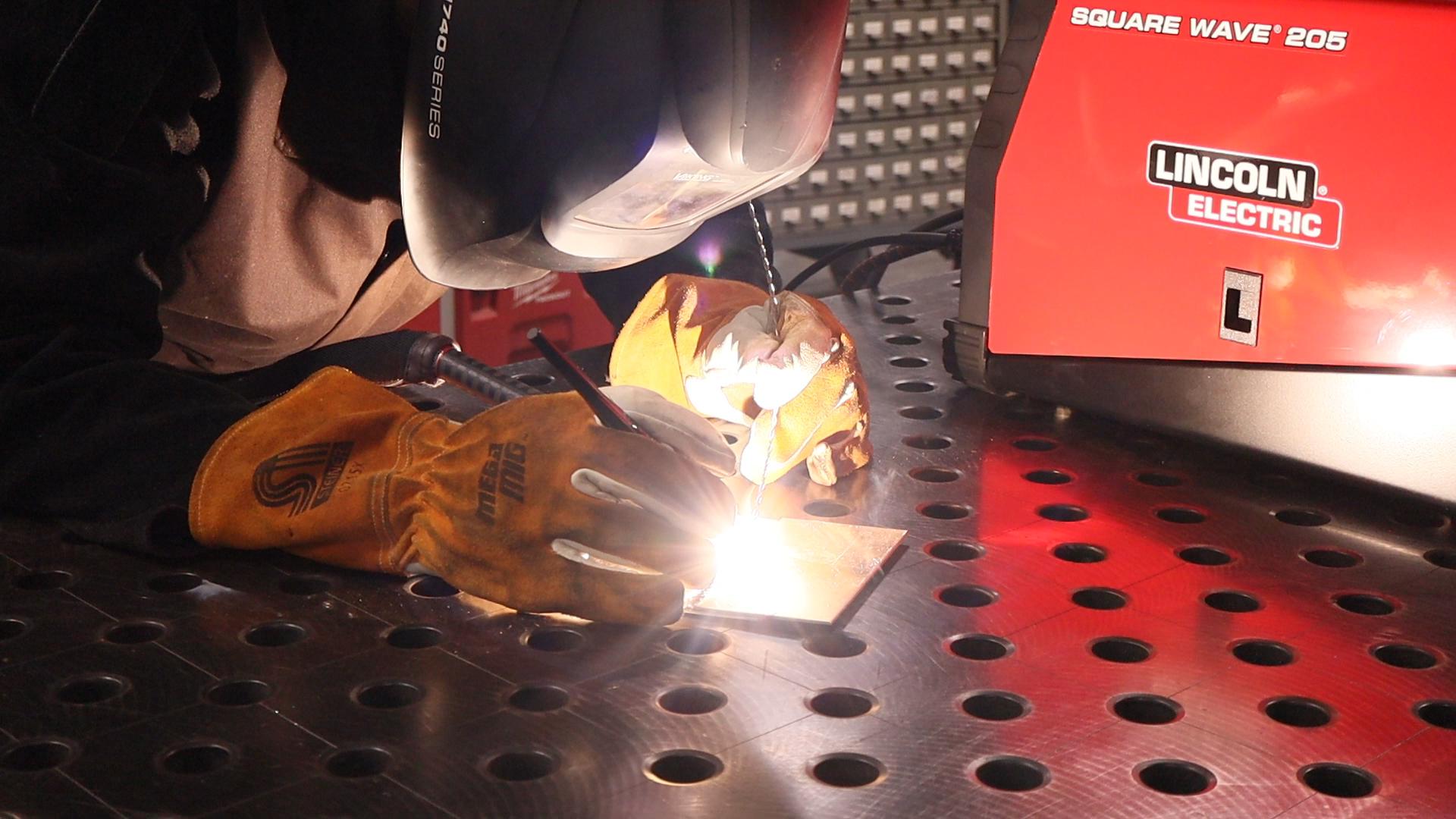
The Square Wave 205 is worth considering for shops that need AC/DC TIG capability without moving into a larger industrial setup. It offers 120V or 230V input, making it a practical choice for a range of shop environments.
If your shop primarily uses MIG but needs aluminum TIG capability, the ESAB Rebel EMP 205ic AC/DC is another option to consider. Its multi-process design can help consolidate equipment when space and budget are limited.
Growing fabrication shops ($5,000-9,000)
As TIG work becomes more frequent, better arc control and additional machine capabilities become more important. The Lincoln Aspect 230 DC is worth considering for shops focused on steel and stainless, while the Aspect 230 AC/DC and Precision TIG 225 and 275 offer options for shops that need AC/DC capability and additional output.
Choose based on the materials you weld, the control features you use and how much capacity you need for future work. You can also compare models in the Lincoln Electric TIG welder collection.
Production, precision and aluminum-heavy shops ($11,000 and up)
For demanding applications, the Lincoln Aspect 375 AC/DC and Precision TIG 375 are options to evaluate. These machines are aimed at higher-output TIG work where capacity, setup and supporting equipment matter as much as the welder itself.
Before investing at this level, consider your actual duty-cycle requirements, power supply, torch cooling and whether a complete package makes more sense than purchasing components separately.
Welding programs and classrooms
Reliability, straightforward controls and a machine that can support a range of learning applications are important in training environments. The Lincoln Precision TIG models are worth evaluating for these needs, with the final choice depending on the program’s materials, power requirements and budget.
TIG welding torches: Air-cooled vs. water-cooled
The torch is easy to overlook when comparing TIG welders, but it can make a noticeable difference in comfort and productivity. Arc Solutions’ TIG welding equipment selection includes machines, torches and related accessories.
Air-cooled torches
Lincoln Caliber 9, 17 and 18 series torches use air cooling through the shielding gas and cable assembly. They’re generally simpler to set up and don’t require a separate water cooler.
The trade-off is heat. During extended welding sessions, especially at higher amperages, the torch can become uncomfortable to hold. Air-cooled setups are often a practical choice for lighter work, shorter welds and shops that don’t regularly operate at high output.
Water-cooled torches
Water-cooled torches, such as the Lincoln Caliber 20 series, circulate coolant through the torch and cable using a cooling unit such as the Lincoln Cool Arc 40.
This setup allows for a smaller, lighter torch head and better heat management during sustained welding. It’s particularly useful for shops doing extended aluminum welds or other demanding TIG applications.
How do you choose?
As a starting point, consider water cooling if you regularly weld above roughly 150 amps or run long aluminum welds. Air cooling can be a reasonable fit for lower-amperage steel and stainless work.
Those aren’t hard cutoffs. The torch’s rated capacity, duty cycle, welding duration and specific application should all factor into the decision. When comparing machines, check whether a torch and cooling unit are included in the welder package or need to be purchased separately.
TIG welder comparison: Models stocked by Arc Solutions.
The following machines cover a range of shop needs, from occasional TIG work to dedicated fabrication and production applications. Use the comparison to narrow your options, then check the product listing for current specifications, package contents and pricing.
| Machine | Output | TIG capability | Best fit | Listed price |
|---|---|---|---|---|
| Lincoln Square Wave 205 | AC/DC | TIG and stick, 120V/230V | Small shops wanting additional AC control | $1,599 |
| Lincoln POWER MIG 220 AC/DC | AC/DC | Multi-process with AC/DC TIG | MIG shops adding aluminum TIG | $2,999 (sale price) |
| Lincoln POWER MIG 215 MPi | DC | Multi-process with DC TIG | MIG shops doing occasional steel TIG | $3,369 (with TIG package) |
| ESAB Rebel EMP 235ic | DC | Multi-process with DC TIG | Mixed steel work using one machine | $3,410 |
| ESAB Rebel EMP 205ic AC/DC | AC/DC | Multi-process with AC/DC TIG | Mixed-process shops that work with aluminum | $3,999 |
| Lincoln Precision TIG 225 | AC/DC | TIG and stick | Fabrication shops and classrooms | $5,656 |
| Lincoln Aspect 230 DC | DC | TIG and stick, pulse, memory | Stainless and precision steel work | $5,795 |
| Lincoln Aspect 230 AC/DC | AC/DC | TIG and stick | Mixed aluminum and steel fabrication | $6,985 |
| Lincoln Precision TIG 275 | AC/DC | TIG and stick | Heavier fabrication requiring more output | $8,109 |
| Lincoln Aspect 375 AC/DC | AC/DC | Industrial TIG | Production and heavy aluminum work | $11,901 |
| Lincoln Precision TIG 375 | AC/DC | Industrial TIG | Production and heavy aluminum work | $12,994 |
Common TIG welder buying mistakes
A few details are easy to miss when you’re comparing machines online. Getting them right before you order can help you avoid spending more than necessary.
- Buying DC-only and then taking on aluminum work. If aluminum is a realistic possibility, compare the cost of an AC/DC machine now with the cost of replacing your equipment later.
- Shopping by maximum amperage alone. Low-end arc stability and duty cycle at your actual working amperage can matter more than the highest number on the spec sheet.
- Assuming lift TIG is a full substitute for a dedicated TIG setup. Lift TIG can be useful for occasional steel work, but your starting method, controls and machine capabilities should match the work you plan to do regularly.
- Overlooking torch cooling. An air-cooled torch may be perfectly adequate for short welds but less comfortable during extended, high-amperage work.
- Forgetting the additional equipment. A foot pedal, flowmeter, tungsten electrodes, cups, shielding gas and other consumables can add to the total cost. Check what’s included before comparing prices.
- Ignoring electrical requirements. Confirm your available input voltage, phase and circuit capacity before ordering. A machine’s power requirements may determine whether it will work in your current shop without electrical upgrades.
What our team recommends
If you’re narrowing the options down, start with your most common material and how frequently you expect to TIG weld. These are the machines we’d put on the shortlist for different shop needs.
- For a first dedicated TIG machine: Start with the Lincoln Square Wave 205. Compare its controls and included accessories to make sure the configuration matches your work.
- For a shop that primarily uses MIG: Consider the ESAB Rebel EMP 205ic AC/DC if you want to add aluminum TIG capability without dedicating your budget to a separate machine for every process.
- For stainless and precision steel: Look at the Lincoln Aspect 230 DC. Its DC output, pulse and memory features make it worth evaluating for shops that prioritize control over aluminum capability.
- For mixed aluminum and steel fabrication: Consider the Lincoln Aspect 230 AC/DC, including a water-cooled One-Pak configuration if your work calls for extended welding at higher amperages.
- For production and heavier aluminum work: Compare the Lincoln Aspect 375 AC/DC and Precision TIG 375. Factor in your duty-cycle needs, available power and the cost of a complete setup before deciding.
The best TIG welder for your shop isn’t necessarily the one with the most features. It’s the one that handles your materials, fits your workload and gives you the capacity you actually need.
Shop Lincoln and ESAB TIG welders
Ready to narrow it down? These are the TIG-capable machines we stock. Check each listing for current specs, package contents and pricing, or view all TIG welders.
Lincoln Electric
- Square Wave 205 TIG Welder (K5613-1)
- Aspect 230 DC (K4346-1) or Aspect 230 DC Air Cooled One-Pak (K4347-1)
- Aspect 230 AC/DC (K4340-1), Air Cooled One-Pak (K4341-1) or Water Cooled One-Pak (K4342-1)
- Precision TIG 225 (K2533-2) or Ready-Pak with Cart (K2535-2)
- Precision TIG 275 (K2619-1) or Ready-Pak (K2618-1)
- Precision TIG 375 (K2622-1) or Ready-Pak (K2624-1)
- Aspect 375 AC/DC (K3945-1) or Ready-Pak (K3946-2)
ESAB
Browse the full Welding Machines collection, explore the Lincoln Electric collection or compare options in the ESAB collection.
TIG welder FAQs
Do I need an AC/DC TIG welder?
Only if you weld aluminum or expect to. DC handles mild steel, stainless and chrome-moly. If aluminum is likely in the next few years, an AC/DC machine like the Lincoln Aspect 230 AC/DC or ESAB Rebel EMP 205ic AC/DC can save you from replacing your welder later.
Can a multi-process welder handle TIG?
Many can. Multi-process machines like the ESAB Rebel EMP 205ic AC/DC add TIG to a MIG and stick setup, which works well for shops that TIG weld occasionally. If TIG is daily work, a dedicated machine usually offers better arc control and starting options.
What’s a good first TIG welder for a small shop?
We usually point small shops and first-time buyers to the Lincoln Square Wave 205 for dedicated AC/DC TIG, or the ESAB Rebel EMP 205ic AC/DC if you also need MIG. Both run on 120V or 230V input.
Should I choose an air-cooled or water-cooled torch?
Air-cooled torches are simpler and fine for lighter, shorter welds. If you regularly weld above roughly 150 amps or run long aluminum welds, a water-cooled torch and cooler, such as the Lincoln Cool Arc 40, will keep things more comfortable.
What else do I need besides the welder?
Plan for a foot pedal, flowmeter, tungsten electrodes, cups, shielding gas and filler rod. Packages like Lincoln’s One-Pak and Ready-Pak bundle much of this, so check what’s included before comparing prices.
Still deciding? Reach out to Arc Solutions today and tell us what you’re welding, how often you’re welding it and what your shop’s power setup looks like. We’ll help you narrow down the options so you can choose a machine that fits the work.
Back to blog